



10 DIY Team Building Activities You Can Run Yourself
DIY team building is what happens when you skip the booking process and run the session yourself, using whatever is already in the supply closet. No facilitator, no venue, no invoice.
I plan events for a living, so this might sound odd coming from me: your team doesn’t need us for every get-together. A 20-minute game on a Thursday afternoon does real work.
Below are 10 activities, each with the time, group size, and materials you’ll need. After the list, I’ll cover how to pick the right one and how to keep it from falling flat.
What counts as DIY team building?
DIY team building is any activity your team plans, sets up, and runs without hiring anyone. Picture an icebreaker before a staff meeting, a lunchtime game, or a longer challenge at a quarterly offsite.
The appeal is obvious. It’s cheap, it’s fast, and you can run it the same week you think of it. The tradeoff is that someone has to own the supplies, the timing, and the energy in the room.
For bigger occasions, our in-person programs and virtual events take the planning off your plate. Both kinds of gatherings earn their keep, and the benefits of team building show up either way.
10 DIY team building activities to try this week
These are easy team building activities you can set up in an afternoon, ordered loosely from quickest to most involved. A few of these DIY team building ideas are the no-budget version of games we sell as kits.
1. Two truths and a lie
The classic earns its place because it needs nothing but people and a few minutes.
- Time: 10 to 15 minutes
- Group size: 3 to 15
- Materials: None
- How to play: Each person shares three statements about themselves. Two are true, one isn’t, and the group votes on the lie.
- Benefits: The fastest way to learn something surprising about the quiet person two desks over.
2. Office bingo
This one runs in the background of a normal workday, so nobody loses an hour to it.
- Time: 20 minutes in one sitting, or a week of casual play
- Group size: 10 or more
- Materials: Printed bingo cards and pens
- How to play: Fill each square with a fact about someone in the office, like “has run a marathon.” People mingle to match facts to names, and the first to fill a card wins.
- Benefits: It forces the cross-department conversations that don’t happen on their own.
3. Warm fuzzies
A TeamBonding favorite for teams who’ve worked together a while and have plenty to say about each other.
- Time: 30 minutes
- Group size: 5 to 20
- Materials: One large envelope per person, plus index cards and pens
- How to play: Everyone writes their name on an envelope. Each person then writes a short note to every teammate naming something that person does well, folds it, and drops it in their envelope.
- Benefits: People walk out holding things their coworkers rarely say out loud.
4. The agree-or-disagree board
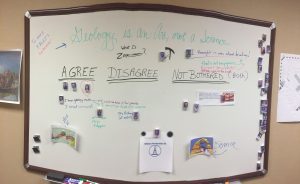
The lowest-effort entry on this list, and one of the stickiest.
- Time: Five minutes a week to set up
- Group size: Any
- Materials: A whiteboard and markers
- How to play: One person posts a low-stakes statement each week, like “pineapple belongs on pizza.” Everyone signs their name under agree or disagree as they walk past.
- Benefits: A running office conversation that never costs anybody a meeting.
5. A DIY escape room
More setup than the rest, and the one teams talk about for months afterward.
- Time: 45 to 60 minutes
- Group size: 4 to 8 per room
- Materials: Padlocks, a lockbox, printed clues, and a room you can close
- How to play: Build a chain of puzzles where each answer opens the next lock. Hide the first clue, start the clock, and let them work.
- Benefits: A DIY escape room shows you fast who organizes, who delegates, and who disappears into one puzzle alone.
6. A self-run scavenger hunt
Good for groups that have been stuck in conference rooms all quarter.
- Time: 60 to 90 minutes
- Group size: Teams of 3 to 5
- Materials: A written challenge list and the phones in everyone’s pockets
- How to play: Give every team the same list of photo and video challenges and a hard deadline. Points for creativity, bonus points for nerve.
- Benefits: It gets people outside and puts the shyest person on camera in the best possible way.

7. Themed trivia
The most flexible option here, since it works the same over a conference table or a video call.
- Time: 20 to 30 minutes
- Group size: 6 to 40, in teams of four
- Materials: A question list and somewhere to keep score
- How to play: Run five short rounds themed around things your team cares about, mixing company history with pop culture so no one group runs the table.
- Benefits: Mixed teams discover who’s been hiding an encyclopedic memory for 90s movies.
8. Coffee pot
A lunchtime guessing game that takes zero prep and gets loud quickly.
- Time: 15 minutes
- Group size: 4 to 12
- Materials: None
- How to play: One person picks a secret verb. Everyone else asks yes-or-no questions with “coffee pot” standing in for that verb, as in “do you coffee pot at work?”
- Benefits: Pure silliness, which is the point. Nobody has to be good at it to enjoy it.
9. Blind build
My pick when a team keeps having the same miscommunication over and over.
- Time: 20 to 30 minutes
- Group size: Pairs or small teams
- Materials: Building blocks or LEGO bricks, plus a photo of a finished structure
- How to play: One partner sees the target and describes it. The other builds it without ever looking at the picture.
- Benefits: Vague instructions produce a crooked tower in about four minutes, and the lesson lands without anyone lecturing.
10. Pipe-and-ball run
The most physical of these DIY team activities, and a reliable closer for an offsite.
- Time: 30 to 45 minutes
- Group size: 8 to 30, split into teams
- Materials: Pool noodles cut lengthwise or lengths of pipe, plus a marble or golf ball
- How to play: Each person holds one piece of the track. The team moves the ball from the start to a container without touching it and without walking while the ball sits on their piece.
- Benefits: Everybody has a job, and the team either syncs up or drops the ball, literally.

How do I choose the right activity for my team?
Start with the constraint you can’t change, then work backward. Usually that’s the clock or the calendar.
A few questions that narrow the list quickly:
- How much time do you really have? Anything under 20 minutes belongs at the front of a meeting you’ve already scheduled.
- How many people are coming? Games built on conversation stall past 15 or so. Break a big group into teams instead.
- Is anyone remote? Trivia and two truths translate well to a video call. The build challenges don’t, though virtual team building kits solve that by shipping supplies to every door.
- What do you want out of it? Pick a looser game for a new team and a build challenge for one working through communication trouble.
- Who’s running it? Match the setup to the time that person can honestly give.
If the answer is “15 minutes and no budget,” our roundup of quick team building activities includes more DIY options built for that window.
What makes DIY team building work?
The activity matters less than the way you run it. The same game can land beautifully or die in silence, and the difference usually comes down to a few things nobody plans for.
Here’s what I’d tell any manager before they try it:
- Name one owner. Shared responsibility for a game means no supplies and no start time.
- Run it on work time. Asking people to stay late for fun is how team building gets a bad name.
- Keep it shorter than you think. Ending while people still want more beats watching the energy drain out of the room.
- Make opting out quiet. Give anyone who’d rather keep score or take photos a real job.
- Skip the long debrief. One question is plenty. “What surprised you?” does more than a slide on collaboration.
- Repeat what lands. One great game run monthly turns into company culture; ten one-offs don’t.
Frequency is the whole trick. Small, regular moments do more for employee morale than one big annual event ever will.
Which team building kits are worth buying?
Buy a kit when sourcing the materials is the part that would stop you. We built our team building kits and employee gifts collection for managers who want the game without the craft-store run.
A few of the best DIY project kits for team building that we stock:
- Pipeline Game Challenge. The boxed version of the ball run above: 12 half-pipes, three different balls, a storage bag, and facilitation notes.
- Blocked Perspective. Fifty wooden blocks, 25 photographs, and five difficulty levels for the blind-build exercise, sized for groups of 6 to 30.
- Connection Toolkit. Books and cards to guide real conversations, suited for teams that are already comfortable talking.
- Table-Talk. One of our simplest icebreaker games, built to warm up a room before a meeting.
- Self-Run High Tech Scavenger Hunts. Fifty photo and video challenges delivered through an app your teams run on their own phones, with optional remote support if you’d rather not play game master.
Kits ship to your office or arrive digitally, and every one comes with instructions written for someone who has never facilitated anything.
Ready to run your own team building event?
Pick one activity from this list and put it on next week’s calendar. That single step is the one most teams skip.
When you’d rather have the supplies handled, our DIY store stocks self-run games, icebreakers, and kits you can order today.
And when the occasion calls for something larger, our event consulting team and fully managed team building programs are here whenever you need us.


Get more insights in our newsletter:
* every subscription supports charity!
PODCAST
Get ideas, inspiration and best practices from across the globe.




Plays well with these activities.