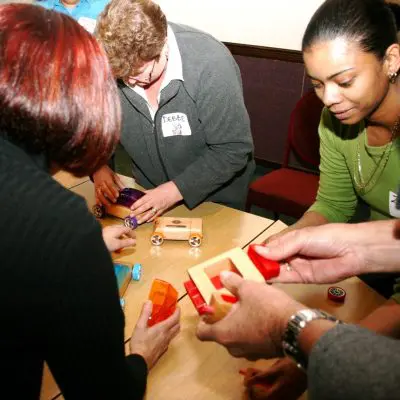



45 New Year Icebreakers for Work in 2027
THE GIST: New Year ice breaker questions are simple team building prompts used at the start of the year to help teams reconnect, reflect on the past year, and set goals for 2027 while boosting morale, communication, and engagement through fun, thoughtful, and interactive conversations and activities.
45 New Year Icebreakers for Work in 2027
The first team meeting back in January has its own sound. Two people are still in holiday mode, somebody’s camera is off, and nobody wants to speak first. That quiet is exactly what New Year’s icebreakers are built for.
As Director of Facilitator Training at TeamBonding, I’ve spent 30 years as an emcee and run hundreds of events a year, so I’ve warmed up many rooms that started out just like this one.
Here’s what you’ll find below: 45 New Year’s icebreaker questions sorted into categories so you can skim and grab one fast. After that, the games I use most and the meeting habits that make any of it stick.
You don’t need all 45. You need two good ones and the nerve to ask them first.

45 New Year’s icebreakers to start 2027
These 45 New Year’s icebreakers work in person, on a video call, or dropped into a chat thread. I’ve sorted them into four groups so you can match the question to the room instead of hunting for one mid-meeting.
One facilitator note before you start. Ask the question, then answer it yourself first. People need to hear what a good answer sounds like before they’ll offer one, and when a leader who goes first, it gives everyone else permission.
Keep it to one question per meeting. If you want more range later, our list of icebreaker questions covers the rest of the year.
Asked consistently, these questions do real work. They’re one of the quieter ways to build a high-performing team because trust builds in small, repeated moments rather than in one big offsite.
Fun and lighthearted questions
These are for the first week back, when the goal is laughter and nothing heavier than that.
- If 2026 were a movie, what genre was it?
- What’s the most unusual resolution you’ve ever heard someone make?
- Which holiday food are you still thinking about?
- If you could skip one month of 2027 entirely, which one goes?
- What was your most-played song last year?
- If this team made one group resolution, what should it be?
- What’s a trend from 2026 you hope doesn’t follow us into 2027?
- If you could spend New Year’s Eve in any city in the world, where would you be?
- What’s the worst advice you got last year?
- If you could hand your January self one small gift, what would it be?
- What’s something you’re secretly good at that nobody here knows about?
- If 2027 came with a theme song, what would you pick?
Reflective questions about the year behind you
These go deeper. Save them for a longer meeting or a kickoff where people have time to think.
- What’s one thing you did last year that you’d do the same way again?
- What’s a problem you solved in 2026 that you’re proud of?
- Which single word sums up your 2026, and why that word?
- What’s something you stopped doing last year that you don’t miss?
- Who on this team made your job easier in 2026?
- What’s a mistake that turned out to be useful?
- When did you feel most proud to work here last year?
- What did you learn about how you work best?
- What’s one thing you want to carry forward into 2027?
- What surprised you most about the past year?
- What’s a small thing that made a big difference in your week?
Answers here often turn into New Year’s resolution ideas for work that people keep, because they came from the person rather than from a template.
Professional questions about the year ahead
These are the New Year icebreaker questions for work that turn small talk into something your team can use in February.
- What’s one professional goal you’re setting for 2027?
- What skill do you want to be noticeably better at by December?
- What would make your workday 10 percent easier?
- What’s one process this team should retire?
- Where do you want more feedback this year?
- What’s a project you’d raise your hand for if we offered it?
- What does a great quarter look like from where you sit?
- What’s one thing you’d like the rest of us to understand about your role?
- How do you want to be supported when things get busy?
- What’s a goal you’d like someone here to hold you to?
- What’s one way we could work better across teams this year?
Quick questions for remote and hybrid teams
Short prompts land best on video, where silence feels twice as long as it does in a room.
- Show us one thing on your desk that wasn’t there last year.
- What’s the first task you do every morning?
- Drop one word in the chat that describes your 2027 so far.
- What’s the best part of your commute, even if it’s ten steps?
- Who’s a teammate you talk to constantly but have never met in person?
- What’s your go-to background noise while you work?
- What’s one change to your setup you want to make this year?
- If we all met up in person this January, what city should we pick?
- What’s a meeting habit you wish we’d all adopt?
- What’s the funniest thing that’s happened on a call recently?
- What’s something you’d like to celebrate that we might have missed?
Which New Year office icebreakers work best as games?
The best New Year office icebreakers give people something to do, not just something to answer. A game lowers the stakes, because now everyone’s attention is on the activity instead of on whoever is talking.
Here are five I come back to every January. All five pair well with the New Year’s icebreakers above, run in under 15 minutes, and need no budget.
Two resolutions and a lie
Everyone shares three resolutions, one of which is invented. The group guesses the fake.
It works because the lie gives shy people cover. They’re not revealing themselves; they’re playing a round, and the real answers slip out anyway.
Prediction bingo
Hand out cards and have everyone fill the squares with predictions for the year: a product launch, a sports upset, a weather event, an office in-joke.
Revisit the cards in June. I’ve watched teams fight harder over a bingo square than a quarterly target, which is its own kind of engagement.
The time capsule envelope
Each person writes a note to their December self, seals it, and hands it in. You open them at the end of the year.
This one costs nothing and pays off twelve months later. If you like trivia-style energy instead, Almost Anything Goes runs on the same instinct.
Gratitude circle
Go around the group and have each person thank someone specific for something specific. “Thanks for covering the Thursday deadline” beats “thanks for being great.”
The specificity is the whole exercise. Vague praise evaporates, and named praise gets remembered.
Vision boards

People collect images, words, and clippings that represent what they want from the year, then walk the group through them.
Suppose half your team rolls their eyes at the idea. That’s fine. The eye-rollers usually produce the most interesting boards, because they refuse to be generic about it.
[IMAGE: existing vision-board-300×200.jpg, alt text unchanged]
If you want a facilitated version of this energy, Improv for Teams and The Big Picture both turn a cold room warm fast. For something with a cause attached, Clean Water Connection has teams assemble water filters for communities that need them.
Charitable programs are my favorite way to open a year. Browse the full set of charitable team building activities if that’s the tone you want to set.
How do you run a successful meeting at the beginning of the year?
A successful January meeting opens with connection and closes with one clear commitment, which is why New Year’s icebreakers belong near the top of the agenda rather than the bottom. Everything in between is logistics, and logistics never gets people invested.
The stakes are real. Gallup’s 2026 State of the Global Workplace data put global employee engagement at 20% in 2025, the lowest figure since 2020.
In that same research, 22% of employees said they felt lonely for much of the previous day. A January meeting that skips straight to the roadmap does nothing about either number.
So here are the beginning-of-the-year staff meeting ideas I’d defend:
- Open with one question and answer it yourself first, so nobody has to guess what you want.
- Go in a set order on video calls, so people stop bracing for the awkward “who’s next” pause.
- Cap the warm-up at ten minutes and say so up front. Teams relax when they know there’s an exit.
- Write down what people say about their goals. Referencing it in March is what proves you were listening.
- End with one commitment the whole team can name, not five priorities nobody will remember.
The order matters more than the content. Connection first, then context, then the ask.
I’ll add one thing I’ve learned from running events for teams: read the room before you commit to a plan. An energized group needs a fast game, and a drained group needs a quiet question and permission to be brief.
If your team leans competitive, game show formats and workplace trivia will get more out of them than a reflection prompt will. Match the format to the people, not to the calendar.
For managers, January is also the moment to connect these conversations to development. Goals surfaced in an icebreaker feed neatly into a leadership development program once the quarter gets going.
Connection in January also compounds. The teams I see thriving in June are the ones that built the habit early, and the research on what makes employees happy keeps pointing back to the same thing: people want to feel known at work.

Make your New Year’s icebreakers the start of something bigger
New Year’s icebreakers aren’t filler. They’re the cheapest way I know to find out how your team is really doing before the year gets loud.
Ask one good question in January. Ask another in February. By spring you’ll have a team that talks to each other without needing a prompt, which is the whole point.
The questions above will get you started. When you’re ready for something bigger than a question, our winter team building activities and virtual events are built to do the same work on a larger scale, and a virtual office party is an easy first step for distributed teams.
Here’s to a 2027 where your team starts the year talking.


Get more insights in our newsletter:
* every subscription supports charity!
PODCAST
Get ideas, inspiration and best practices from across the globe.




Plays well with these activities.