

Building an Ownership Mentality That Drives Team Success
Most teams don’t fail from a lack of skill. They stall because no one has built an ownership mentality, and no one feels truly responsible for the outcome. Deadlines slip, problems get tossed around like hot potatoes, and “that’s not my job” quietly becomes the unofficial mission statement. Sound familiar?
I’ve spent more than two decades at TeamBonding helping companies fix exactly this kind of drift. The single most powerful shift I’ve watched teams make is adopting an ownership mentality. As an author, speaker, and founder of Quixote Consulting, I’ve worked with organizations as different as the NFL, Giorgio Armani, and New Balance, and the pattern holds across every industry. My approach centers on putting each person’s unique strengths into play every day, and when people feel that trust, real performance follows.
In this article, I’ll walk you through what an ownership mentality really looks like, the benefits it delivers, practical strategies for building it on your team, and how to push through the resistance you might meet along the way.
What does it mean to take ownership at work?
Taking ownership at work means treating your role, your decisions, and their outcomes as if the whole business depends on you—because, in many ways, it does. It’s not about fancy titles or equity. It’s about caring enough to follow through, raise your hand when something is broken, and stick around to fix it.
That’s the heart of an ownership mentality: a genuine sense of personal ownership over your work, paired with the willingness to be accountable for the results, good or bad. When that mindset spreads across a team, the whole dynamic shifts.
And right now, this matters more than ever. According to Gallup’s State of the Global Workplace 2026 report, global employee engagement fell to just 20% in 2025, costing the world economy an estimated $10 trillion in lost productivity. The U.S. isn’t faring much better, with active engagement sitting at 31% in 2025, down from a high of 36% in 2020. Disengagement is the opposite of ownership, and it’s expensive.
The benefits of an ownership mindset for teams
An ownership mentality pays off in ways you can both feel and measure. Here’s what changes when your people start showing up as owners.
Enhanced collaboration and teamwork
One of the clearest wins is stronger collaboration. Communicating effectively is essential in any workplace, but it’s something most teams quietly struggle with. An ownership mindset reframes communication from a chore into a shared responsibility, because owners care about being understood.
Morale rises along with it. People feel valued, they understand why their work matters, and they want to bring their teammates along for the ride. That’s the difference between a group of coworkers and an actual team.

Greater responsibility and accountability in the workplace
A culture of ownership and accountability in the workplace is one of the strongest predictors of team success I’ve ever seen. Each person, regardless of title, takes responsibility for their work. If they hit it out of the park, great. If they miss, they own that too, and they get to work fixing it.
Without that, teams quickly slide into finger-pointing and blame. With it, you get something increasingly rare: a group of people who treat the team’s wins and losses as their own.
Increased motivation and engagement
Motivation and engagement are the lifeblood of a healthy team, and they’re harder to maintain than ever. Engaging teams gets even trickier when people are remote or hybrid.
Ownership in the workplace fixes this by closing the gap between the daily work and the bigger picture. When employees see how their contributions feed the company’s larger vision, they stop punching the clock and start driving outcomes. The data backs this up: Gallup research finds that highly engaged business units are 23% more profitable than disengaged ones.
Personal ownership and individual growth
Beyond team-wide wins, an ownership mindset changes people individually. Personal ownership builds confidence. When you take credit for what goes right and learn from what goes wrong, your sense of self-worth grows in a healthy, grounded way. It also nudges people toward growth, because owners are naturally curious about how they could do better next time.
There’s a wellbeing benefit too. Low morale can quietly drag mental health down, but the energy of a job you genuinely care about lifts both your work life and the rest of your life. People who take personal ownership tend to feel less stuck, less resentful, and more in control of their own day. That’s no small thing.
Strategies for developing an ownership mentality within your team
Knowing the benefits is the easy part. Building the habit takes intention. Here are three strategies I rely on with the teams I work with.
1. Empower your team to take ownership of their work
This one sounds simple, but it’s where most leaders fall short. Empowering people means putting them in roles that match their strengths, then trusting them to deliver.
People who love what they do, understand why it matters, and feel trusted to make decisions naturally take more ownership. Your job as a leader is to remove obstacles, not to hover. The more autonomy you offer, the more accountability you tend to get back.
2. Set clear expectations and goals
Clear expectations are the foundation for everything else. People can’t own what they don’t understand, and they can’t deliver against goals they’ve never seen.
Be specific about outcomes. Spell out what success looks like. Co-create the targets where you can. When goals are clear and shared, ownership follows almost automatically because people now have something concrete to rally around.
3. Encourage open communication and honest feedback
For people to take ownership, they have to feel that their voice carries weight. That means making space for input in meetings, treating tough questions as a sign of engagement rather than dissent, and offering constructive feedback instead of criticism.
Open communication is also a two-way street. Ask your team for feedback on you. Few things accelerate trust faster than a leader who genuinely wants to know how they can do better.

Leadership shapes ownership in the workplace
Before we get into challenges, I want to be honest about something: an ownership mentality is built from the top down. If leadership isn’t modeling it, no team-building exercise in the world will save you.
There’s a great example on the Team Building Saves the World podcast. Lia Garvin, bestselling author of Unstuck and a former team operations leader at Google, Microsoft, Apple, and Bank of America, shared a story. A who told his team they could wear jeans on Friday. Nice gesture, right? But when Friday came, everyone showed up dressed up. Why? Because the CEO did.
That’s the whole point, right there. Your team watches what you do, not what you say. If you want them to own their work, own yours first. That includes admitting mistakes, reflecting publicly on lessons learned, and holding yourself to the same standard you set for everyone else. As Garvin put it during her interview, when teams have a real sense of ownership, they’re proactive when problems come up. They’re not pointing fingers, and they’re not waiting for someone else to fix things.
Overcoming challenges in developing an ownership mentality
Culture change is rarely smooth. Resistance is normal, and so is a wobble in communication while new habits take root. The good news is that both are very solvable.
The most common roadblock is plain resistance to change. People like what’s familiar, even when it isn’t working. The fix is mostly transparency: explain what’s shifting, why it matters, and what’s in it for them. Then back it up with experiences that build trust and prove the new way works.
A few of my favorite ways to do that:
- For self-awareness and team dynamics: Our Team & Leadership DNA program uses the Belbin Team Roles framework to give each person a clear picture of their natural strengths and how they fit into the larger team. When people understand exactly what they uniquely contribute, ownership stops feeling abstract and starts feeling personal.
- For collaboration across silos: Bridging the Divide puts teams in the dual role of supplier and customer, building physical bridge sections that connect into one giant company-wide structure. It’s a powerful metaphor for how ownership works at scale; you own your section, and you own how it integrates with everyone else’s.
- For purpose-driven ownership: The Do Good Bus takes teams to a mystery volunteer location for a day of meaningful community service. There’s no faster way to ignite a shared sense of purpose than working side by side on something that matters beyond the bottom line.
- For trust and problem-solving: A High Tech Scavenger Hunt gets teams making real decisions together under time pressure, which is essentially ownership in miniature.
- For communication breakdowns: Our Catapult to Success event tackles communication and collaboration head-on through a hands-on engineering challenge that requires every voice in the room.
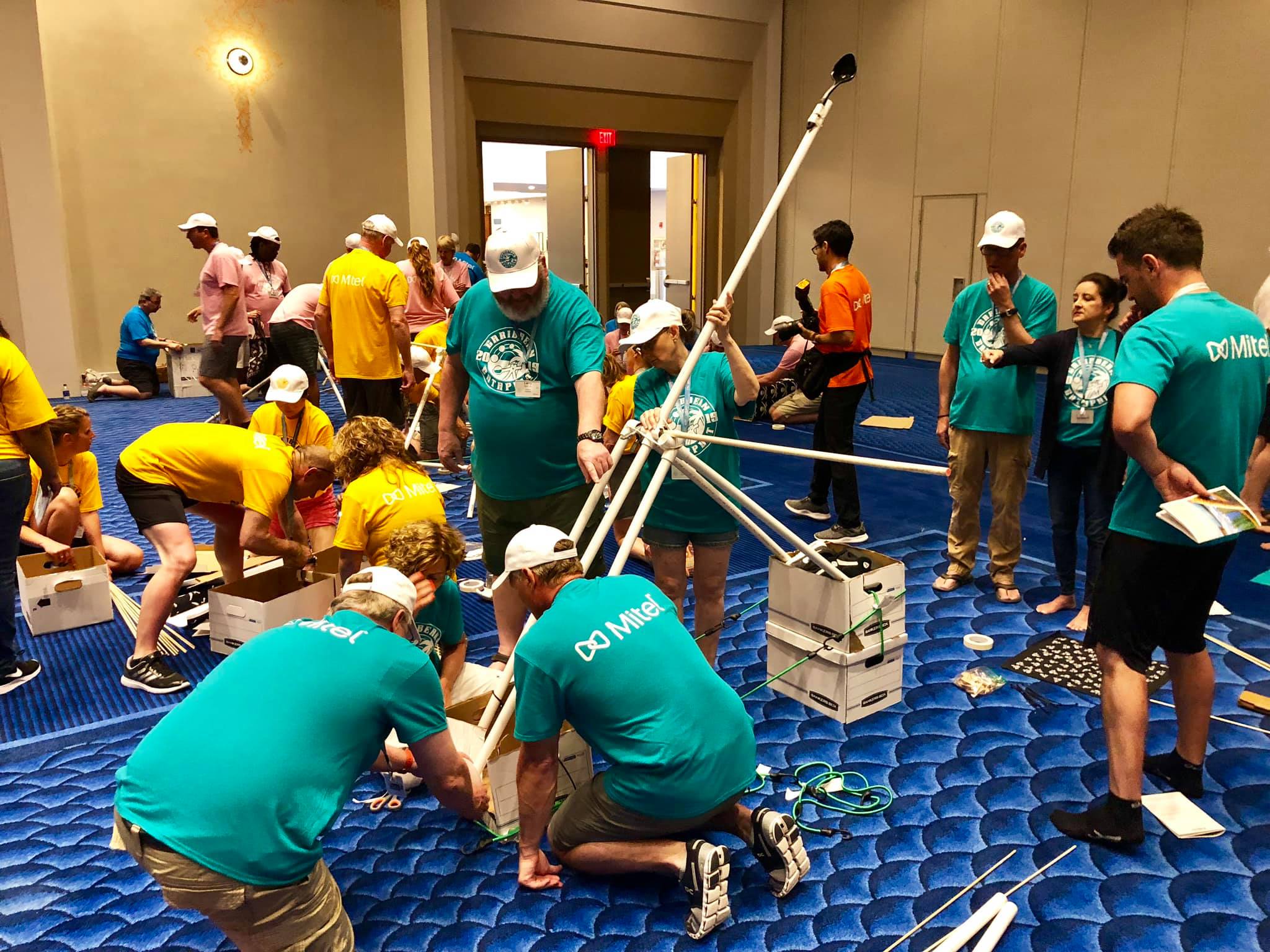
The point isn’t the activities themselves. It’s what they unlock in your team. People come back to the office having proven, in a low-stakes setting, that they can step up, communicate, and own outcomes together. That confidence carries straight into the daily work.
Start building an ownership mentality today
Team success starts with an ownership mentality, and it starts with you. If you want your people to step up, you have to step up first. Build the muscle in yourself, model it for your team, and then give them the support and the experiences they need to grow into it themselves.
Don’t wait for the perfect moment. Develop an ownership mentality now by partnering with TeamBonding. We have a huge selection of events designed to help you and your team build the skills and the trust that real ownership requires. Get in touch with us today and start building the kind of team where everyone shows up like an owner.


Get more insights in our newsletter:
* every subscription supports charity!
PODCAST
Get ideas, inspiration and best practices from across the globe.




Plays well with these activities.