


Innovation in the Workplace: Building a Culture Where Creativity Thrives
A culture of innovation doesn’t just happen; it’s built with intention. And today, one of the most powerful tools for doing that is fostering a growth mindset at work. In companies where innovation thrives, employees aren’t afraid of failure. They’re curious. They ask bold questions. They challenge “the way we’ve always done it.” And they do that because the environment supports it.
If you’re wondering how to make your workplace more innovative, the answer lies in how you think and how your team thinks. Let’s look at what it takes to create an innovative culture powered by a growth mindset.
What is innovation in the workplace?
Innovation in the workplace is the process of translating creative ideas into tangible improvements—whether that’s new products, better processes, enhanced services, or novel approaches to old problems. It’s not just about invention. It’s about implementation.
True workplace innovation combines three elements: creativity (generating new ideas), problem-solving (addressing real needs), and execution (turning concepts into reality). You can have the most creative team in the world, but without the ability to execute, innovation remains theoretical.
Innovation shows up differently depending on the context. Sometimes it’s disruptive—completely reimagining how an industry works. Sometimes it’s incremental—small continuous improvements that compound over time. Both matter. Both drive growth.
Why innovation matters more than ever
The business landscape has never changed faster. Technology evolves daily. Customer expectations shift constantly. Competitive advantages disappear overnight. In this environment, innovation isn’t optional—it’s essential for survival.
Here’s what innovation drives:
- Competitive Advantage: Innovation helps you stay ahead of competitors and disrupt markets before you’re disrupted
- Business Growth: New products, services, and processes create new revenue streams
- Efficiency Gains: Process innovations reduce costs and improve productivity
- Employee Engagement: People are more engaged when they can contribute ideas and see impact
- Talent Attraction: Innovative companies attract the best people who want to work on meaningful problems
- Customer Loyalty: Customers stick with companies that continuously improve their experience
- Adaptability: Innovation builds organizational muscle for responding to change
Companies that innovate consistently outperform those that don’t. Look at 3M—they earn around 3,000 patents a year for new products and designs. That constant innovation is how a company stays relevant across wildly different industries for decades.
How to build a culture of innovation
A culture of innovation doesn’t just happen—it’s built with intention. And today, one of the most powerful tools for doing that is fostering a growth mindset at work. In companies where innovation thrives, employees aren’t afraid of failure. They’re curious. They ask bold questions. They challenge “the way we’ve always done it.” And they do that because the environment supports it.
1. Cultivate a growth mindset
A culture of innovation doesn’t just happen—it’s built with intention. And today, one of the most powerful tools for doing that is fostering a growth mindset at work. In companies where innovation thrives, employees aren’t afraid of failure. They’re curious. They ask bold questions. They challenge “the way we’ve always done it.” And they do that because the environment supports it.
Here are a few strategies for promoting growth mindset among employees:
- Celebrate effort, not just outcomes.
- Reward experimentation and learning, even when the result isn’t perfect.
- Provide training opportunities that stretch people outside their comfort zones.
- Encourage reflection. What worked, what didn’t, and what’s next?
2. Encourage Open Communication and Psychological Safety
Innovation is a team sport. But people won’t share their ideas if they fear being judged, shut down, or ignored.
To foster innovation within the workplace, you need an environment where everyone feels safe to speak up. That starts with:
- Leaders modeling curiosity and openness
- Setting norms around listening and respectful debate
- Having dedicated time and space for idea-sharing: whether it’s a brainstorming meeting, a digital whiteboard, or a Slack channel just for ideas
Cross-functional collaboration is especially effective. When people from different departments interact, they bring unique perspectives to the table, often leading to unexpected and exciting solutions.
As Diane Egbers said on the Team Building Saves the World podcast, “What we want to do is help people to see that it takes all types of people to get optimal results… We have kind of one way of looking at the world based on our strengths, style, and genius. But there are lots of other ways to look at it, and we embrace that and welcome that.”

3. Empower Employees to Think — and Act — Like Leaders
Ownership is key. When employees feel responsible for outcomes, they’re more likely to innovate. Connection isn’t a “nice-to-have.” It’s foundational to influence and empowerment. As Diane Egbers put it, “Until I’m connected to somebody, I virtually have no chance to influence them as a leader.”
You can empower employees by:
- Giving them autonomy over how they approach problems.
- Letting them lead initiatives or pilot new processes.
- Encouraging mentorship and peer learning to spread knowledge across your team.
One example we’ve seen at TeamBonding: our facilitators are encouraged to share ideas for improving events and creating new experiences. Some of our most successful team building activities came from these frontline insights!
Empowerment also means creating space for employees to bring forward bold ideas, even if they challenge the status quo. One way to do this is by rotating team members into temporary leadership roles during internal projects or off-site activities.
Programs like Corporate Survivor put these leadership skills to the test in a fun, high-pressure environment, helping teams build resilience, delegate effectively, and think strategically under time constraints. When employees experience what it’s like to lead, even temporarily, they gain confidence, insight, and a deeper sense of ownership, all of which are essential for creating a culture of innovation.
4. Create Space for Risk-Taking and Experimentation
Innovation doesn’t happen in back-to-back Zoom calls or under constant pressure to be perfect. To foster real creativity, you need to create space for experimentation and risk-taking and a culture that supports both.
Teams need time to explore ideas without fear of failure. Companies like Google famously encouraged employees to spend 20% of their time on passion projects. While not every team can carve out that much space, even a few hours a month can spark meaningful breakthroughs.
What’s equally important is the mindset. Failure can’t be taboo; it needs to be data. Encourage teams to take calculated risks, share what worked (and didn’t), and build a feedback loop focused on progress.
Ways to create experimentation space:
- Internal innovation time: Dedicate regular time for passion projects or experimental work
- Pilot programs: Test new ideas on a small scale before full rollout
- Innovation budget: Set aside resources specifically for experimentation
- Safe-to-fail projects: Designate some initiatives as learning opportunities where failure is acceptable
Encourage teams to take calculated risks, share what worked (and didn’t), and build a feedback loop focused on progress.
5. Invest in Professional Development
While a growth mindset starts with culture, it deepens through deliberate learning. Support your team’s development by investing in skills, stretch experiences, and real-world innovation challenges.
Try:
- Bringing in guest speakers on innovation and mindset
- Offering stipends for classes or certifications
- Hosting innovation-focused team building programs that challenge people to collaborate and solve complex problems
Pro Tip: Programs like Integrity from TeamBonding are designed to help teams practice communication, problem-solving, and adaptability: key traits of innovative teams.
6. Design Environments That Inspire
Physical and digital workspaces impact how people think and collaborate. A cluttered, dull, or isolating environment can stifle creativity.
It doesn’t have to be a radical redesign. Consider simple changes like:
- Open layouts that encourage collaboration
- Spaces for quiet reflection and deep work
- Art, natural light, and flexible seating
In hybrid or remote teams, encourage virtual co-working sessions or idea-sharing channels to spark connection and creativity.

7. Set Goals That Inspire Innovation
Innovation without direction is chaos. Your team needs to understand what they’re working toward and how their ideas align with bigger objectives.
That means:
- Defining your innovation mission (e.g., “Make our onboarding process the best in the industry”)
- Sharing progress regularly
- Recognizing contributions that move the needle
This is especially powerful when combined with a growth mindset. Clear goals give people a sandbox to innovate within.
8. Reinforce Innovation Through Celebration and Connection
Culture isn’t built in a single breakthrough. It’s shaped moment by moment, win by win. To sustain innovation, it’s essential to keep momentum going and recognize the effort that fuels it.
Celebrate the small wins. Share stories of creative problem-solving. Reflect openly on what worked and what’s next. “You can’t just keep pushing for results and think that relationships will manage and cultivate on their own,” says Diane Egbers. Recognition fuels motivation and helps employees feel that their contributions matter.
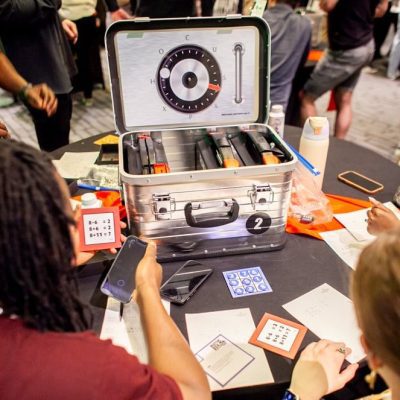
One of the best ways to reinforce this culture is through shared experiences. Team building activities aren’t just fun. They create a foundation of trust, communication, and collaboration. That’s why programs like Beat the Box and Escape the Mob are popular and transformational. When teams feel connected, they take more creative risks, solve problems faster, and engage more deeply.
Other options include In It to Win It, which adds a playful, competitive edge that brings out problem-solving under pressure, and Go Team, a high-tech scavenger hunt where teams navigate the real world with a digital mission by unlocking clues, completing challenges, and adapting in real time. It’s creativity in action.
Overcoming Innovation Blockers in the Workplace
Even the most forward-thinking teams can struggle to innovate. That’s because fostering creativity isn’t just about adding new programs. You have to remove the friction that stops it.
Fear of Failure
The biggest innovation killer? Fear. When employees believe failure will hurt their reputation or career, they stop taking chances.
Tip: Normalize failure by celebrating “lessons learned.” Have a monthly team debrief where employees share what didn’t work and what they learned from it.
Micromanagement
Innovation needs room to breathe. If every decision has to go through layers of approval, momentum stalls.
Tip: Build trust by empowering teams to test ideas on a small scale. Use pilot programs and feedback loops to give people autonomy without risking major disruption.
Unclear Direction
Without a clear purpose, even the most creative ideas can get lost.
Tip: Align innovation goals with your company’s mission. For example, if your goal is to improve customer experience, challenge teams to pitch one innovation that simplifies the user journey.

Innovation and the Remote/Hybrid Workplace
If your team works remotely or in a hybrid environment, connection is still possible and still just as critical to innovation.
Use Digital Tools to Drive Idea Sharing
Create space for creativity across time zones with tools like:
- Virtual whiteboards (Miro, MURAL)
- Async brainstorming via Slack threads
- Collaborative docs with voting features for prioritization
Encourage “thinking out loud” even when you’re not in the same room.
Create Rituals Around Innovation
Build consistent rhythms for creativity:
- A monthly “innovation jam” where teams pitch ideas
- Weekly “what if” questions in your team meeting
- Cross-team coffee chats to spark unexpected insights
Consider creating a Slack channel called “bright ideas” — a space for casual, no-pressure idea sharing. Let your team share ideas and then follow up on them.
Make Remote Team Building Part of Your Strategy
Virtual team building can be fun and strategic. It helps build trust, improve communication, and strengthen the relationships that drive collaboration.
Explore remote-friendly innovation experiences like:
- Virtual Taskmaster: Work together to complete tasks that are judged by creativity, teamwork, and performance.
- The Official Jeopardy!® – Virtual Game Show: Complete with all the sounds and games you know and love, this can also be completely customized to your company.
- Virtual Escape Room: Teams work together to solve puzzles, persevere through failure, and communicate with each other to escape a virtual haunted house.

These programs put your team’s problem-solving skills to the test, while reinforcing the kind of playful, experimental mindset that innovation depends on.
Building a Culture of Innovation Is a Choice. Make It Yours.
Creating a culture of innovation through a growth mindset isn’t a one-time initiative. It’s an ongoing commitment to learning, experimenting, and evolving together.
Whether you’re a CEO, a team leader, or someone passionate about positive change, your role in shaping workplace culture is powerful.
Want to see what this looks like in action? Explore all of TeamBonding’s experiences that can help your team start thinking outside of the box.
Innovation doesn’t just happen. You create the conditions. And with the right mindset, anything is possible.


Get more insights in our newsletter:
* every subscription supports charity!
PODCAST

Get ideas, inspiration and best practices from across the globe.




Plays well with these activities.