

The Real Team Building ROI: What Connection Returns to Your Bottom Line
Somewhere in your building, a finance person is reviewing a line item for a team building event and asking a fair question: what do we get back for this? It’s a question that trips up a lot of HR leaders, because team building ROI doesn’t arrive as a tidy number on a quarterly report.
It shows up as the project that didn’t stall, the manager who didn’t quit, and the two departments that finally stopped emailing each other in code.
I’ve been running these events for more than 37 years, and I’ve worked with about 80% of the Fortune 100 along the way. In that time, I’ve watched plenty of leaders struggle to defend a budget they know in their gut is working.
So let’s take the guesswork out of it. I’ll walk through the tangible returns you can measure, the intangible ones that quietly hold everything together, what it costs to skip the investment, and how two of our longest-running clients prove the point better than any spreadsheet could.
What does team building ROI really mean?
Team building ROI is the total return your organization gets from investing in the relationships between your people, measured in both hard numbers and hard-to-quantify outcomes. The mistake most companies make is looking only at the first half of that sentence.
Think of it like preventive maintenance on a building. You don’t get a bonus for the fire that never happened. You get a lower insurance bill and a business that keeps running.
The value of team building works the same way. A big chunk of the return shows up as costs you never had to pay.
That said, “you can’t measure it” is a cop-out, and I’d never let one of my directors get away with it.
The tangible returns you can measure
The clearest evidence for the ROI of team building comes from what happens to teams when engagement climbs. Gallup’s Q12 meta-analysis, covering more than 183,000 business units, compares the most engaged teams to the least engaged. The gaps are enormous:
- 23% higher profitability in top-quartile teams versus bottom-quartile teams
- 18% higher productivity, measured in sales
- 78% lower absenteeism
- 51% lower turnover at organizations with historically low turnover, and 21% lower at high-turnover ones
- 32% fewer quality defects and 63% fewer safety incidents
I want to be careful here. A single event doesn’t flip a team from the bottom quartile to the top. Engagement is built by managers, day after day, and Gallup pins roughly 70% of the variance in team engagement on the manager.
What a well-designed event does is give those managers something to build on. It creates the shared reference points, the trust, and the goodwill that make everything else a manager tries land better. That’s the mechanism behind the importance of team building, and it’s why the numbers move at all.
The intangible returns that don’t fit on a spreadsheet
The intangible side of team building ROI is the part I’ve spent my career watching, and it’s the part clients still talk about years later. It looks like this:
- People from different departments who now have a reason to pick up the phone instead of filing a ticket
- Employees who feel comfortable admitting they don’t understand something in a meeting
- Managers who’ve been seen laughing at themselves, which does more for trust in the workplace than any policy memo
- New hires who feel like they belong before their 90-day review
- Quiet people whose good ideas finally have a path to the room where decisions get made
None of that lands on a P&L directly. All of it shows up eventually: in retention, in speed, and in the quality of the work.
Ingerman: 16 years of compounding returns
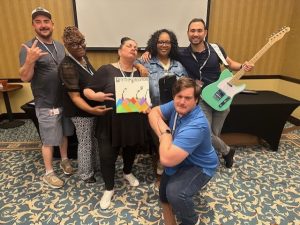
Ingerman, a development and property management company with roughly 350 employees, has partnered with us for 16 straight years on their annual leadership conference. That’s the closest thing to a longitudinal study you’ll find in this business.
Their workforce spans four states and splits among developers, construction crews, corporate staff, and property managers. These are people who depend on each other daily and almost never meet face to face.
We’ve adapted programs like In It to Win It and the Charity Guitar Build to whatever theme they pick, from a circus year to a “Denim and Diamonds” year.
Mary French, their Area Vice President, told us we make it easy to run a dynamic event without pouring thousands of hours into figuring out how to make it work.
Now for the ROI part. Ingerman’s CFO, David DeAugustine, has said the conversations and connections formed at these events keep going long after the conference ends, helping employees navigate challenges and strengthen relationships across the company.
When the CFO is the one telling you the connection outlives the event, the value of team building has stopped being a debate.
The Do Good Bus: when the return reaches beyond your team

Juniper, a network innovation company where philanthropy is a stated core value, brought 25 employees on our Do Good Bus program in Lowell, Massachusetts. Nobody knew where the bus was going until it got there.
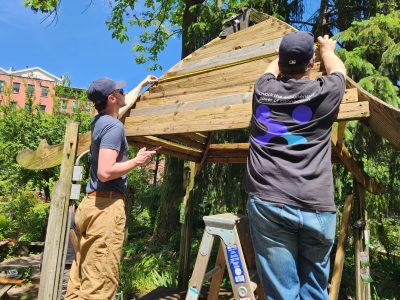
Where it went was the Lowell Transitional Living Center, a shelter serving 60 men. The group spent four hours repainting the dayroom in the men’s dorm and pitching in on office work around the shelter. Staff there said the room looked dramatically better after just the first half hour.
That team building case study shows a charitable event returning value in three directions at once. The team got a shared experience they’d talk about for years. The company got visible proof that its stated values are real, which is worth more to recruiting than any careers page. And 60 men got a better place to live.
The cost of not investing in team building
The strongest argument for team building ROI isn’t what you gain. It’s what you’re already losing without it.
When people ask me “is team building worth it?” I start by asking what disconnection is currently costing them. The answer is almost always more than the event.
Turnover and replacement costs
Replacing an employee costs between one-half and two times their annual salary, according to Gallup, and voluntary turnover drains roughly $1 trillion a year from U.S. businesses. For a manager earning $90,000, one exit can run six figures once you count recruiting, onboarding, and the ramp-up months.
The maddening part is how much of it is preventable. Over half of departing employees say their manager or organization could have done something to keep them, which is why employee retention and team building are so tightly linked.
Employee disengagement
Global employee engagement fell to 20% in 2025, its lowest point in five years, and Gallup’s State of the Global Workplace report puts the cost at an estimated $10 trillion in lost productivity worldwide.
Disengaged employees don’t storm out. They stay, do the bare minimum, and take their discretionary effort home with them. You’re paying full price for partial output, and it spreads across a team.
Team conflict
Unresolved friction is expensive in ways that never get coded to a budget line. SHRM’s Civility Index research finds U.S. workers experience over 200 million acts of incivility a day, costing organizations north of $2 billion daily in reduced productivity and absenteeism.
Most of it starts small: a curt email, a meeting where someone gets talked over. People who’ve built rapport outside of work extend each other more grace inside it, and they resolve small things before those things calcify.
Communication breakdowns
Grammarly and The Harris Poll have estimated that poor communication costs U.S. businesses as much as $1.2 trillion annually. In their 2024 research, every single knowledge worker surveyed reported hitting miscommunications weekly.
Tools aren’t the fix. Most breakdowns come from people who don’t know each other well enough to ask a clarifying question without worrying about how it’ll look. That’s a relationship problem wearing a technology problem’s overcoat.
Project delays caused by poor collaboration
When two departments don’t trust each other, work doesn’t stop. It slows down, which is harder to spot and easier to excuse. Handoffs get padded with approvals, decisions wait for a meeting, and nobody wants to be the one who flags the problem.
Add up a few weeks of drag across a few projects a year and you’ve spent far more than an event costs. Improving cooperation between coworkers is one of the cheapest speed upgrades available, and it compounds directly into workplace productivity.
Is team building worth it after layoffs or mergers?
Yes, and these are the moments when the ROI of team building is at its highest. A merger takes two groups who don’t know or trust each other and asks them to perform as one, usually on a deadline. A layoff leaves survivors carrying guilt, anxiety, heavier workloads, and doubts about leadership.
Both situations produce the same thing: a trust deficit. And a trust deficit is precisely what team building is built to close.
I’ve said before that the period right after layoffs or restructuring is critical for retention and morale, and that companies that actively rebuild trust and engagement can reduce voluntary turnover. Team building isn’t nice-to-have in those moments. It’s how you protect the team you still have.
Our guide on motivating teams after layoffs and mergers goes deep on tactics. The core idea is simple: get people in a room, give them a shared goal that has nothing to do with the org chart, and let them see each other as people again.
How to measure the value of team building
Start measuring before the event, not after. Most companies skip this step and then wonder why they can’t prove anything. Track these six things:
- Baseline engagement and retention for participating teams, then check again at 90 and 180 days.
- Run a short pulse survey right after the event and again a month later. Ask about trust, clarity, and whether people feel safe raising problems.
- Track cross-department requests. If teams that met at your event start collaborating more, that’s a direct signal.
- Watch your exit interviews. Look for what people stop citing as reasons for leaving.
- Compare turnover between participating and non-participating teams over a year.
- Collect the stories. Qualitative feedback is data. Ingerman’s CFO noticing that conversations continued after the conference is a result, not a compliment.

My honest answer on the ROI of team building
Team building ROI is real; it’s measurable if you bother to set a baseline, and the biggest returns are the disasters that just never happen.
The companies that get the most out of it treat it as an ongoing investment in how their people relate to each other, not as a party they throw when morale dips.
Ingerman didn’t come back for 16 years out of sentiment. They came back because it works, and because their leadership can see it working in how people talk to each other the other 362 days of the year.
If you’re building the business case, start with what disconnection is costing you today. Then take a look at how we work and what an event costs. I think you’ll find the math friendlier than you expected.


Get more insights in our newsletter:
* every subscription supports charity!
PODCAST

Get ideas, inspiration and best practices from across the globe.




Plays well with these activities.