
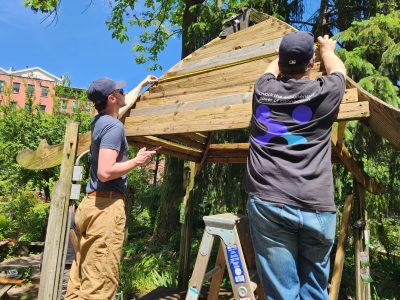


STRONG TEAMS DON’T HAPPEN BY CHANCE 
Making Work More Human
w/ Leilani Garrett

Use the buttons above to listen now.
Transcript - Making Work More Human
Rich Rininsland: On this episode of Team Building Saves the World …
Leilani Garret: A team is better when the individuals care more and know each other better. If you tell me a story today that resonates with me in some ways, our brains sync up. It’s called neural coupling.
All empathy isn’t radical. But radical empathy happens to be radical.
Prince said one time, “Money doesn’t buy happiness, but it’ll pay for the search.”
Rich Rininsland: Hello, team. It’s me, your old friend Rich Rininsland, host of Team Building Saves the World. And today, have I got a story to tell you. Recently, I had the pleasure of sitting down with writer and founder of Be More Human, Leilani Garrett, and we spoke about how the simple act of listening to each other’s stories can help organizations create environments where employees feel genuinely connected to each other and their work.
But before we can dive in, I have to share some love with all of my supporters at TeamBonding. If your team is ready to experience teamwork through the power of play, then visit teambonding.com to learn more. Now, team, let’s listen to the story and creative strategies of Be More Human’s founder and principal storyteller, Leilani Garrett.
Leilani Garrett, thank you so much for coming on the podcast. We appreciate having you here. How are you today?
Leilani Garret: I’m well today, Rich. Thank you for having me. I’m delighted to be here.
Rich Rininsland: Good. My team out there are very curious to know who you are, and usually at this point I ask you just to tell you a little bit about yourself.
Instead, I’m gonna ask you a very specific question. You are… it is listed for me as the founder and principal storyteller of Be More Human. What is Be More Human and what does that philosophy mean, and how did you come to it in your life?
Leilani Garret: Oh interesting question. The philosophy means, one of the things that I’m really passionate about, two things actually, storytelling and human connection.
Rich Rininsland: Okay.
Leilani Garret: And Be More Human is about us, all of us, taking moments, taking the opportunity to see the other human being, and really understand them a little bit, and maybe provide some value to them if we have the opportunity to do that. And so, my work is all about sharing that information via storytelling, and keynotes, and workshops and off-sites, that kind of thing. So teaching folks little tidbits about storytelling and how to listen to their other humans, and how to share stories that really connect us together, and I think most importantly, build this web of empathy. I think the world is lacking a hell of a lot of… no empathy.
Rich Rininsland: I completely agree. I have discussed this many times throughout many past episodes. My team out there, if you don’t know these already go look in past episodes. We talk about empathy all the time here.
Leilani Garret: Crucial in business and life.
Rich Rininsland: So what was it you saw, if you don’t mind my asking, that made you realize that this methodology, your methodology at Be Human, can lead to better connectivity amongst people?
Leilani Garret: It’s interesting because I’m a writer, so I’ve written a novel. I’m in the process of writing another one. Very nice. That’s something I feel really energized about. And I was working with a marketing, I’ll call her a savant, ’cause she’s a genius, just about a website and what we wanted to do for the author website.
And she did a whole two-day intensive who are you Leilani.
And it was alarming actually. I cried a number of times. And what we came up with really was my passion for storytelling and my really deep desire to help humans be better at being more human. And so that’s really the genesis of it.
And I’ve learned over the years in corporate America and in some research that teams are certainly more productive, more successful, more innovative, all the things you want a team to be when they know each other better and/or care about each other more.
Rich Rininsland: Okay. But why have you found in your research aren’t they already doing this?
You would think, I understand that, I’m in a cubicle all day every day. It’s hard for me to get to know the person across the room from me, let alone the person right next to me. But, why? Why aren’t companies taking that simple idea of get to know your neighbors and enjoy being with them to heart and putting, making it part of their corporate culture?
Leilani Garret: I think it’s our corporate legacy, our corporate history. I started years ago at IBM, and I was thinking about that this morning. We liked each other, we talked, but we didn’t dig into who the other person was, how their morning went.
I think the legacy of corporate America is about being about the money, about the growth, about the revenue, and it’s a stiff kind of… At least it started that way. With tech bros and the tech industry, it has softened-
Rich Rininsland: Yeah …
Leilani Garret: in some ways, at least outwardly. But I don’t think that there’s a lot of talk about building a team that’s cohesive and innovative and caring about each other. But there’s less practice, I would say.
Rich Rininsland: Okay. So let’s dig in. What kind of practices are you recommending for these companies and these people to help their people get to know each other better?
Leilani Garret: There are a number of them. I guess I’ll take one. I’m gonna, I’m gonna…
Rich Rininsland: Yeah, you don’t have to give away the story here. I still want them to call you and say “Tell me what you, tell me what you know.” But yeah give me an example.
Leilani Garret: I’ll give you an example with my own child.
Rich Rininsland: Okay, great.
Leilani Garret: And I tell this story in some of my keynotes. And I raised a son. He’s 36. He’s an English teacher here, just outside of Chicago in Evanston.
Rich Rininsland: Impressive.
Leilani Garret: And thank you. I’m very proud of him. But I used to, you’d pick your kid up from school and you say, “How was your day?”
Rich Rininsland: Yeah.
Leilani Garret: And they say what? “Fine.”
Rich Rininsland: Yeah.
Leilani Garret: And that’s all you get. And so, in middle school I’m asking this question, I’m getting “fine,” and I’m like I’m not learning anything about this kid’s day.
So I started to ask very specific questions. And one was “who were you kind to today? Who was kind to you today?”
Rich Rininsland: Okay.
Leilani Garret: “Was the most fun thing you did today, and what was the most challenging thing you did today?” And so he started to know before he got in the car that I was gonna ask these questions, and he had his answers. And I learned a lot more about how this child’s day went. It was just little stories about who was kind to him. And I thought, “This is not what we do as our neighbors but wouldn’t it be great if we did?”
Rich Rininsland: So what’s the differ… or not even what’s the difference, the difference is obvious, but why is that more powerful in a corporate setting than just worrying about the bottom line?
Leilani Garret: Because the bottom line is this abstract, non-personal… yeah, money’s personal but it’s not personal to me as a human. It’s this abstract thing, and when we focus on the abstract as opposed to the humans around us, we lose the ability or at least the tendency to spend our time and energy on them.
I believe that we are one thing. So l- let’s go meta for a minute. I think we’re one. There’s this idea that the universe is energy, and it’s in and through all things. And you can make it religious, or you can make it spiritual, or you can make it whatever you wanna make it. Scientific. And I think because we’re made of the same stuff-
Rich Rininsland: Yeah
Leilani Garret: we’re one thing. And I think, an old Bible verse is, “I am my brother’s keeper.”
You can turn that into religion. I just turned into to human-ness. If someone next to me or around me is hurting, how can I help them? How can I do something for them? It might be just a kind word. It might just be a smile.
Deepak Chopra says, “Give something to everyone you encounter.”
Rich Rininsland: Nice.
Leilani Garret: Maybe it’s a smile. Maybe it’s a wonderful thought, just something. Give away something positive. It creates this web of goodness around the world, I think.
Rich Rininsland: But again, thinking about this from the corporate side that being Gen X, I came up in, where it’s not supposed to matter that a lot of this to upper management C-suite people sounds like that’s time taken away from making me the money that I want to see, that the shareholders wanna see. So why? What’s the value behind it?
Leilani Garret: The value… let’s take innovation, for example.
Rich Rininsland: Please.
Leilani Garret: You want an innovative team.
You want a team that’s thinking ahead, that’s coming up with ideas that aren’t necessarily the norm or something that has already happened. If I’m on a team and I don’t feel… appreciated, maybe respected, considered, I’m not gonna pitch a wild idea in a meeting. Why would I do that?
Rich Rininsland: Okay.
Leilani Garret: So I maybe have a great idea that’s innovative, and what is innovation but a wild idea, something that hasn’t happened before.
Rich Rininsland: Yeah.
Leilani Garret: I’m just gonna sit back and let all y’all talk- … and I’m not gonna say what I think is a good idea because I don’t trust you.
Rich Rininsland: Okay.
Leilani Garret: So we need teams of individuals who trust each other, who actually in many ways care about each other. The team is better when the individuals care more and know each other better.
We’ll be more innovative. Actually, revenue goes up, too, so duh.
Rich Rininsland: How does that happen?
Leilani Garret: That happens because we’re more focused on helping each other achieve the things that we collectively say we want to achieve, rather than competing with each other.
Systems in corporate America… I’ll give you an example. I worked at corporation. I won’t say the name of it. I’ve been in a number of them. And the way the sales guidelines were set up had me competing with my peer.
Rich Rininsland: Yep.
Leilani Garret: Had me competing with someone who had the same accounts that I had in Zurich. And we literally got into, we got into stuff because money was on the table.
Rich Rininsland: Yeah.
Leilani Garret: And it doesn’t support or promote folks being cohesive and creating a good, successful, innovative, high-flying team.
So let’s look at how we structure the sales plans, and how we structure the way individuals work together when we could likely be in a competitive situation.
Rich Rininsland: Okay, let’s talk about that. Let’s… so there’s purpose-driven, and then there’s the actual human experience. What do you see is the differences between the two, and how can we get people to understand that the actual employee’s experience can be just as important as that bottom coin?
Leilani Garret: More important not just as important. It’s the thing that drives the bottom coin. Example, I worked at IBM right out of college.
Rich Rininsland: Okay.
Leilani Garret: And we were having real internal competitive issues, because I sold a certain type of solution. It was hardware at the time. And my… There was another division that sold a different type of hardware, but they kinda could do the same stuff.
And so the client or the prospect could buy from me and get what I had to offer, and solve their problems, or they could buy from the big iron division and get what they needed, and solve their problems, and we knew that. Okay. So we’re both in there trying to fight for one client.
Which is absolutely ridiculous. And when Lee Gersner came in, the new CEO at the time, he realized that all these competing divisions were really taking the business down.
Rich Rininsland: Yeah.
Leilani Garret: And so his edict, his first, one of his first edict was, “I want, the heads of these divisions to sit down, to talk, to understand each other, to see why this isn’t working, and then let’s structure our systems to actually not do some of the same things.
Or if we do, we have to have some guidelines around it that doesn’t support this cutthroat competitive environment.” Because that’s exactly what it was. We were fighting amongst ourself- … and losing business because we couldn’t get along together.
Rich Rininsland: Yeah. If you’re that client talking to two parts of the same company, and they’re not only not talking to each other, but they’re fighting each other, why would you continue working with that company?
Leilani Garret: I’m out. Yeah.
Rich Rininsland: But how does storytelling get us there, though? What is it about storytelling that makes us realize that the whole is better than the individual? Or cooperatively, the individual being just as important as the whole, if not more.
Leilani Garret: The individuals make up the whole, right? So if the individuals are sad and lame and sorry, then there’s gonna be some component of the whole that is reflective of that. Storytelling is like the original empathy API. I like to say that.
Rich Rininsland: Okay.
Leilani Garret: And the reason is because when people, when there’s like this wonderful arc of a story, if you tell me a story today that resonates with me in some ways, our brains sync up. It’s called neural coupling.
Rich Rininsland: Okay.
Leilani Garret: We literally have the same rhythm brainwaves at the same time when you’re telling me the story.
And so it resonates with me. It kinda lands on my bones, and I have an opportunity to be like gee, that, that meant something.
Now, how does that reflect my life? What do I learn about this person now that I can celebrate or share?”
Rich Rininsland: You talk about radical empathy.
What is it that’s radical about empathy, first off?
Leilani Garret: All empathy isn’t radical, right? But radical empathy happens to be radical.
I am a word girl, so I love words.
Rich Rininsland: Yep.
Leilani Garret: And radical is just a, it’s a curious word. Some people find it inflammatory. Some people find it exciting.
Rich Rininsland: Yeah.
Leilani Garret: But radical empathy is… an example, if I happen to walk into a coffee room, or the barista, wherever we are in tech, we had great baristas.
That was a fabulous part of the tech industry. Maybe it still is. I hope it is. And you’re sitting and talking to, maybe you’re standing next to the guy who’s ordering a coffee.
If I have an opportunity to ask him, not, like, how his morning went … and he goes ” – it’s been a tough morning.”
” Oh, I’m sorry to hear that,” and then I walk on my way.
Rich Rininsland: Yeah. It’s the fine answer. And…
Leilani Garret: Yeah, it’s fine. Yeah. “I’m sorry to hear that,” and I’m gone. That’s purported empathy.
Rich Rininsland: Okay.
Leilani Garret: Radical empathy is, “Is there anything I can do to make your morning better?” Or maybe I see that he’s buying a coffee. Maybe I buy it for him. I do something. Radical is doing something to impact this individual who I’m having this conversation with or hearing this story from.
Rich Rininsland: Okay. Now let’s talk about how we get that to leadership… because the one thing I have heard said over and over again throughout my now seven years doing this is that the reason people leave a company is because of the management they work under.
Leilani Garret: Absolutely
Rich Rininsland: How do we get management to understand not only the effectiveness, but to the point where they’re using radical empathy?
Leilani Garret: I think we have to present them with data.
Rich Rininsland: Okay.
Leilani Garret: There’s a lot of, I’m all about the human side, but there’s a lot of data that suggests when a leader cares about his people or her people or their people and understands and seeks to elevate them and teach them and learn from them as well, their revenue grows by a certain percentage, and I don’t have the number in my head now, but revenue’s increased, innovation is increased. You can hold onto employees for a lot longer. So all this spin that we’re doing when we lose an employee and have to hire another one, that diminishes. Everything changes when a leader is empathetic, interested, compassionate, and really serving those individuals on their team as opposed to, “You’re not making your number.” ” You gotta go.” How about not, “Look you’re not making your number. What’s the problem?”
Rich Rininsland: Yeah.
Leilani Garret: Maybe ask a question like, “What sort of challenges are our customers experiencing that you are not actually attacking that maybe we could attack?”
Ask a different question.
Rich Rininsland: How do you get that leader though who grew up the old way of the numbers aren’t being met instead of, “What’s going on that you’re not meeting the numbers?” to, “How are you today?” Because that’s not where their minds automatically go. That’s not where they were trained to go in the beginning.
So how do we get those older managers to understand this is a better method?
Leilani Garret: The question becomes do you wanna win or do you wanna keep being mid as the young kids would say?
Rich Rininsland: Gotcha, gotcha.
Leilani Garret: And so it’s just… And again, I’m gonna go back to the data. You have to present the data. They have to buy into the data. I’ll give you another example. Microsoft in, I wanna say 2015 or so… not doing so great.
It was blamed on the CEO.
The stock was at $35 forever.
It was going nowhere. And Satya came in, and he said, “You know what?” And I was there at the time. And his first memo actually said, there was an article, a Vanity Fair article, that talked about the lost decade of Microsoft, and how Facebook and everyone else was just… apple, Google, whizzing past. Squeezing all of them. And his memo literally said, “This industry does not respect legacy.” ” This industry only respects innovation,” and I’m paraphrasing. And then he said, “Empathy is the thing that drives innovation.” And so what happened is he made everybody talk to each other.
It was, like, more one Microsoft, kinda one IBM. And they have… Look at them today. A lot has happened since then that was very positive in terms of growth, in terms of Azure, in terms of all the things they do. And it really had to do with him saying… and the sales team structure was dreadful at the time.
And I think anyone who was there can attest to that. We fought a lot and competed a lot. An example, sometimes there are just procedural roadblocks that need to be resolved.
You could be a high performer at Microsoft back in the day and if there are five people on the team, and you could be killing it and be the fifth person on the team, but everybody else was ahead of you, you’re not gonna get the grade, the mark that you want to get because it was relative.
Rich Rininsland: Okay.
Leilani Garret: I could be at 120%, but my peers are at 180, 190, 200. I’m the one on the team who’s gonna get a four as opposed to a one.
Rich Rininsland: Gotcha
Leilani Garret: Just because how do you do that? Why do you do that? Why would you do that? So procedural roadblocks that create these limited opportunities for people to flourish have to be changed.
And so I think the data has to be presented to these folks. You get them in a workshop. You show them why and how it works. And then you give them micro exercises that they can deploy daily, that they can have their team to deploy daily. And there are games that they can play that build these muscles of caring about each other and empathy.
Rich Rininsland: Okay Why is it taking so long, though? Why would it take Microsoft 10 years to figure out “Whoa … this is what they need to do?” Why is it so hard to grab the horse by the reins and pull it into a better direction?
Leilani Garret: Yeah. It’s such a great question, Rich. I think that change is hard.
And people are resistant to change. And if we go back to the Industrial Revolution, it was all about money. Money and unfortunately, there are folks who are still just about that.
Rich Rininsland: Yeah.
Leilani Garret: Not realizing that it doesn’t, you have money, it’ll make your life ostensibly better in terms of how it appears.
Prince said one time, “Money doesn’t buy happiness, but it’ll pay for the search.” Which I thought was a really great line.
But change is hard, and I think the foundation of corporate America still exists. And you have to get a jackhammer… and, really just mess that up and build a new foundation, and that’s not something that’s gonna happen in a lot of organizations easily.
Rich Rininsland: So reach out if you can right now to one of those managers out there who is thinking, “I like the old way because I made money the old way.” And you can always promise them more money, but if they’re not willing to risk it, give them a reason they should try.
Leilani Garret: So I would say, “Jay, you’re making money. That’s great. And you like the old way, and the old way works to a certain point. But everything must change. The young become the old. Everything must change. And so you could keep doing this and have a measure of success and bliss perhaps in your life. But do you care about, A, making more money and, B, being more fulfilled as a human being and giving your gifts in a more sub- substantive way? Does that matter to you? If it doesn’t, say it doesn’t, and I’m moving on. If it might matter to you, then let’s talk about how that can be done, no risk.”
These things don’t cost money. They don’t cost money. When you stand… An example, maybe there’s someone on the team who’s very quiet, like a silent contributor, and there’s usually someone or two who are like that. They don’t speak up at meetings, but what they do is valuable and contributing.
Rich Rininsland: Sure.
Leilani Garret: Who celebrates them? Maybe you pick one on your Monday standup, and you talk about what Lee did last week that made a huge difference, and let Lee talk if Lee wants to talk.
But celebrate the people in a way, the ones who aren’t like the showy ones who are always winning. We know who they are. These are small things you can do to make your team stronger, better, more cohesive. Oh by the way, and you be a more successful leader. If you wanna be a old school leader, you can do that.
I’m not mad at you for that, but, this is new school, so maybe move on.
Rich Rininsland: Is it just that easy? Is it literally just get my people to tell their story?
Leilani Garret: It’s get your people to stop, pay attention to the stories that other people tell.
Rich Rininsland: Okay.
Leilani Garret: Ask more specific questions.
Rich Rininsland: Okay.
Leilani Garret: If someone shows up at a meeting late, and she comes in flustered, and, maybe her teammates are like, “Ugh, she’s always late. I can’t believe it. It’s… I’m so tired of her. If I was late… I can’t be late, she’s late.”
But they didn’t know that she has a three-year-old and a newborn. She has to get the three-year-old to daycare.
Rich Rininsland: Yeah.
Leilani Garret: And, oh by the way, she lives over here. And so for her to get there at 8:00 AM is very difficult, but you live down the block and you can walk.
These are things that folks need to know so that they have more empathy, more compassion for one another.
Rich Rininsland: Okay.
Leilani Garret: And then she’s more successful because she’s not as flustered. She’s not thinking that people think she’s, not doing what she needs to do to get to work on time. These are… So that’s a story.
Listening to her story one morning, talk about how hard it was for her to get to work, changes you and how you view her.
Rich Rininsland: Yeah. I’m gonna dip my toe here into something, and you tell me whether or not this is something we really should be talking about. But what about that manager who is just thinking, “I can just wait for AI to be better”?
Leilani Garret: Oh, my goodness.
Rich Rininsland: Oh, don’t even get me started. ‘Cause that’s what we’re hearing nowadays, though.
Leilani Garret: Wait for AI to get better and to do what?
Rich Rininsland: To do the job where I don’t need to care about it. It just does the same job. You’re shaking your head at me. For those who are just listening, she is shaking her head at me like I just said something horrible.
Leilani Garret: So as a writer, I find AI interesting.
I don’t like it when I’m going to write something and AI goes, “Let me write it for you.” No. I’m a writer. I got this. Thank you very much.
However, AI at this moment has a long way to go. It might…
You can wait. You’re gonna be waiting a minute, I think.
And by a minute, a while, because AI does not, at this particular time, understand context so well.
Rich Rininsland: Okay.
Leilani Garret: It doesn’t understand nuance so well. It can crutch through all kinds of data and spit out information, quote-unquote information.
But making decisions on that information has proved problematic with some AI. So there’s room for AI to grow big time.
Now, the humans have to get a handle on where they want AI to go.
That’s probably the bigger problem than AI. But yeah, no, waiting on AI to do a job that you don’t have to worry about, that’s…
Then why don’t you just go do something else? ‘Cause that seems really short-sighted and robotic.
Rich Rininsland: Which is where AI comes in. Yeah, exactly right. So Leilani, this has been fantastic. But I do wanna change gears just a little bit here and talk about… ’cause we’ve been talking a lot this season about CSR, corporate social responsibility. Where do you see storytelling and empathy involved in that, that sense of a company learning to give back to the community and how important that impact is?
Leilani Garret: Yeah. I think that’s a really great question. I’m actually working on something called Storytelling For Leaders, which I haven’t done before.
Rich Rininsland: Nice. Okay.
Leilani Garret: And with a nonprofit. And so the idea of, you can go and say, “We’re going to clean up Puget Sound. And we’re gonna spend this much money doing that.” “And gee, look how much money we spent. Wasn’t that great?” But the stories of, did we save a ton of animals? Let’s see them. Let’s feel them. Let’s hear them. Let’s know what happened.
If we’re feeding kids, then let’s show Isabella, who has now breakfast every morning, and let’s talk to her and ask her the difference between not getting breakfast and getting breakfast. We have to show the human side of the work that corporate social responsibility is doing, not the numbers.
The numbers are the numbers. Perch charts and all these different things are okay. They’re important, but they don’t… We should take those things, and you could say we fed 1,000 kids last year.
Rich Rininsland: Yeah.
Leilani Garret: And let’s talk to three of them. So take those things. and turn them into the stories of the people that, or the stories of the animals that you absolutely helped.
Rich Rininsland: And of course, those stories from the children you fed or who you gave a bicycle to or… maybe it’s the people who actually did clean Puget Sound that you helped finance to make it happen. Hearing from them, hearing their stories makes more stories for the people who helped get them there.
Leilani Garret: Absolutely. That’s it. ‘Cause you, stories are resonant. They have emotional content.
And percharts and bar charts and all those things do not.
And numbers and spreadsheets do not.
Rich Rininsland: Yeah. Yeah. We do a bike build. It’s one of our classic events that we host, and it used to be pre-pandemic that we would have the organization bring kids to get bicycles that were going to be given away to that organization. We can’t do that now just because it… post-pandemic it’s become more problematic than it was before. Sure. But there is still that moment at the end where I remind everybody what it was like for them as children, and they get to share those stories about what it was like when they got their first bike.
And what it meant to them. So yeah, it’s, it very much can be people’s stories combining with everybody else’s stories, and you find out our stories aren’t different.
Leilani Garret: They really aren’t. They’re really a lot the same.
Rich Rininsland: Yeah.
Leilani Garret: That’s the thing that connects us, when we realize, “oh, this, this person has this”, some of the problems I have, or some of the dreams I have or some of the challenges I have. That’s what it’s like, “Oh I see you.”
Rich Rininsland: Yeah.
Leilani Garret: And that’s what matters.
Rich Rininsland: Yeah. So before we move on, my friend, can I just ask, let’s talk to that leader out there one more time. What’s one thing we can ask them to do to make their corporation, their group, their team, however big or small it happens to be, more human-centered, more involved in the workplace?
Leilani Garret: So what’s the one thing they can do?
Rich Rininsland: Yeah, just one. One thing they can do today that could make a difference.
Leilani Garret: There are these things that you can do with your team or ask them to do weekly if you want them to do it, and one is, and this is a simple one, when someone is speaking to you, don’t interrupt.
Just don’t interrupt. Give ’em 90 seconds to tell their story.
Rich Rininsland: Okay.
Leilani Garret: Let it settle. Let them be heard, and then you can ask questions or then you can make a statement. But I think that we, we’re in such a hurry to make a comment or say what we’re thinking, when we’re not listening to the other human.
It starts with curiosity. Be curious about the people on your team. If you want your team to be curious about one another, then you, Mister, Miss Leader, have to be curious about them. So I would just say the first thing is be curious about the people on your team. Don’t make assessments based on their resume or where they came from or what they look like.
Be curious about that human being. Start there, and then help them understand that they can be curious about each other. And you guys will really build something substantive and successful, more successful than the way you run it now.
Rich Rininsland: Fabulous. Fabulous. Leilani Garrett, everybody. Give her a big round of applause.
Thank you, Leilani.
Leilani Garret: I love that.
Rich Rininsland: Just a small group of people I keep chained up under my desk. Their entire job is just to applaud you for being here.
Leilani Garret: I won’t tell Rich.
Rich Rininsland: I won’t. That’s okay I’ve been saying it for seven years. Everybody knows by now, and yet no one has come to stop me. Anyway, leilani, did you have a good time?
Leilani Garret: I had a great time.
Rich Rininsland: I did too.
Leilani Garret: Thank you. Good questions. Lots of fun.
Rich Rininsland: You were fantastic. Thank you so very much. I hope you continue to enjoy yourself because, Leilani, it’s time for my speed round.
Leilani Garret: Okay.
Rich Rininsland: Now, I did tell Leilani before the show started, but just so she and everybody remembers, this is just 60 seconds of me asking completely silly, innocuous questions just to get to know Leilani a little bit better, to hear more of her story in short, compact answers.
If you are feeling at all challenged, Leilani, we’re trying to beat 16 questions.
Leilani Garret: Okay.
Rich Rininsland: Okay? I’m gonna play some music. That just keeps me in track of the time. If you are ready, my friendo, shall we begin?
Leilani Garret: Let’s go.
Rich Rininsland: All right. What’s your name?
Leilani Garret: Leilani.
Rich Rininsland: How many kids do you have, Leilani?
Leilani Garret: One.
Rich Rininsland: How many pets?
Leilani Garret: Two.
Rich Rininsland: If you could ask your pet a question and get an answer, what would it be?
Leilani Garret: Why do you leave your food and go and try to eat her food just ’cause you’re eating? What is that about?
Rich Rininsland: Perfect. Biggest inspiration of your life?
Leilani Garret: My mother.
Rich Rininsland: What job would you be terrible at?
Leilani Garret: Oh, accountant.
Rich Rininsland: Pancakes or waffles?
Leilani Garret: Pancakes.
Rich Rininsland: What would you like to be your last meal?
Leilani Garret: Ooh ooh. Steak, mashed potatoes, some really good green beans. A beautiful red.
Rich Rininsland: If you could pick a nickname for yourself, what would you choose?
Leilani Garret: Sparky? I don’t know
Rich Rininsland: Favorite thing about your grandparents?
Leilani Garret: I did not know them.
Rich Rininsland: Okay. Favorite children’s book?
Leilani Garret: Charlotte’s Web.
Rich Rininsland: 12. 12, buddy. That was really good. That’s actually, we call that…
Leilani Garret: Oh, I only got 12? Man.
Rich Rininsland: That’s about average. That’s about average for how people do.
Leilani Garret: Ugh, who wants to be average?
Rich Rininsland: But for somebody who makes a living telling stories, you’re really good at quick, short answers. I like it.
Leilani Garret: Thank you.
Rich Rininsland: Thank you, Leilani. Thanks for coming on.
Leilani Garret: It was my joy. Thank you, Rich. Thank you all for inviting me.
September 24, 2026
In this episode, Rich speaks with Leilani Garrett, founder of Be More Human, about the role of human-centered leadership in building stronger, more successful teams.
Leilani explains how storytelling, empathy, curiosity, and genuine connection can help leaders better understand their employees and create an environment where people feel valued, trusted, and empowered to contribute. They explore how human-centered leadership can drive innovation, collaboration, employee retention, and business results, and discuss practical ways leaders can put these principles into action, such as asking more thoughtful questions, listening without interrupting, and recognizing quieter team members.
As AI continues to reshape the workforce, Leilani details why leaders can’t afford to lose sight of human connection.

About Leilani
Leilani Garrett is the Founder and Principal Storyteller of Be More Human, where she helps leaders build stronger workplace cultures through storytelling, radical empathy, and authentic communication. After more than three decades in corporate leadership and sales, she founded Be More Human to help organizations foster trust, strengthen relationships, and create environments where employees feel genuinely connected to their work and each other.
“The team is better when the individuals care more and know each other better.”
Leilani Garrett
Get ideas, inspiration and best practices from across the globe.




Subscribe Wherever You Listen To Podcasts




More great podcast episodes.
Season 7 | Episode 7
What Happens After the CSR Event?
Season 7 | Episode 6
Turning Sustainability Into Employee Engagement
Season 7 | Episode 5
Building Brain-Healthy Workplaces
Season 7 | Episode 4
Bringing Compassion Back Into the Workplace
Season 7 | Episode 3
Corporate Responsibility and Sustainability
Season 7 | Episode 2
Empathy, Insight, Impact
Season 7 | Episode 1
The L&D Approach That Actually Works
Season 6 | Episode 18
That’s a Wrap!